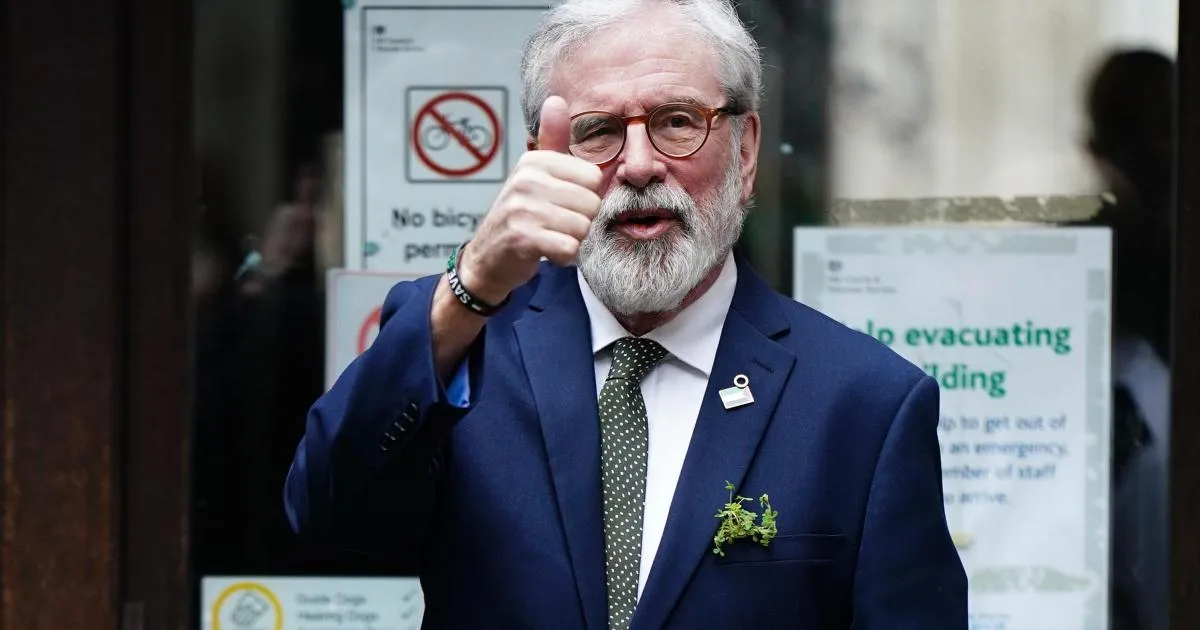
“I had no involvement whatsoever in the authorisation, planning or conduct of the bombings in which the claimants were sadly injured,” stated Gerry Adams during his testimony at the Royal Courts of Justice in London on March 17, 2026. This statement comes as Adams defends himself against a legal claim brought by three victims of IRA bombings that occurred in England.
The claimants allege that Adams was a leading member of the Provisional IRA during the time of the bombings, which resulted in significant casualties. In his defense, Adams emphasized, “As I have always stated, Sinn Fein and the IRA are separate organisations.” This distinction is central to his argument, as he seeks to separate his political role from the violent actions attributed to the IRA.
Adams, who served as president of Sinn Fein from 1983 to 2018, has consistently maintained that his political affiliation does not imply direct involvement with the IRA. He reiterated this point in court, claiming, “I do not defend all the IRA actions but my position is based on the broad principle that people have the right to resist occupation.” His comments reflect a long-standing narrative that seeks to contextualize the actions of the IRA within the broader struggle for Irish nationalism.
During the proceedings, Adams acknowledged the impact of the Provisional IRA’s actions, agreeing that 1,178 deaths were caused by the organization. This admission underscores the severity of the allegations against him, as the claimants seek a symbolic 1 pound in damages for their suffering.
The Provisional IRA was involved in numerous bombings in England during the 1970s and 1990s, a period marked by significant violence and political turmoil. Adams’ testimony is a critical moment in the ongoing legal battle, as it not only addresses the claims made against him but also reflects the complex legacy of the conflict in Northern Ireland.
As the trial progresses, Adams’ statements will be scrutinized, and the implications of his defense may resonate beyond the courtroom. He expressed relief over the current state of affairs, stating, “I’m glad that the IRA has left the stage, I’m glad that no one else is being killed.” This remark highlights a shift in the political landscape since the Good Friday Agreement, which aimed to bring an end to the violence.
The trial is expected to conclude later in March 2026, with both sides preparing for the final arguments. The outcome could have significant ramifications for Adams and the historical narrative surrounding the Provisional IRA and Sinn Fein.