In the lead-up to April 11, 2026, expectations surrounding public demonstrations in London were marked by a growing tension between activists and law enforcement. The UK government had recently designated Palestine Action as a terrorist organization, a move that drew significant criticism and concern over free speech and the right to protest. Many believed that the government’s stance would stifle dissent and lead to increased police presence at public gatherings.
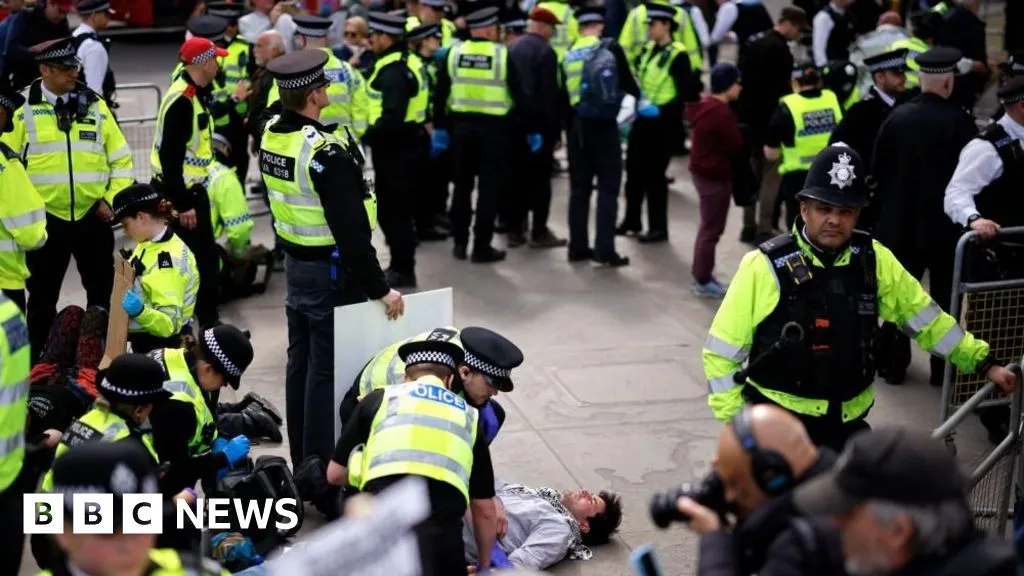
However, the situation escalated dramatically during a mass vigil in Trafalgar Square, where approximately 1,500 participants gathered to express their opposition to the government’s actions. The atmosphere was charged, with demonstrators voicing their discontent over the proscription of Palestine Action. This event marked a decisive moment, as police arrested 212 individuals, with ages ranging from 27 to 82, highlighting the diverse demographic of those involved in the protest.
The immediate aftermath of the arrests revealed a stark contrast between the intentions of the demonstrators and the response from law enforcement. Many participants expressed feelings of betrayal, believing that the police were not there to protect their rights but rather to enforce government policies. Qesser Zuhrah, a prominent voice at the vigil, stated, “It just shows that the Met police, they don’t serve us, they don’t protect us, they work only to reinforce what the government wants.” This sentiment resonated with many attendees, who felt that their freedom of expression was under threat.
In a parallel development, Irish police, known as An Garda Siochana, announced their intention to increase enforcement against fuel-cost protesters blocking critical infrastructure. This decision came in response to a blockade at the Whitegate oil refinery, which was cleared in about an hour. The Commissioner of An Garda Siochana emphasized that illegal activities by fuel protesters were endangering the State, indicating a broader crackdown on dissent across the UK and Ireland.
Experts have weighed in on the implications of these events, noting that the government’s classification of Palestine Action alongside groups like al-Qaeda and Hezbollah raises serious questions about civil liberties in the UK. The High Court’s ruling on February 13, which deemed the government’s proscription unlawful, was seen as a significant victory for advocates of free speech. However, with the government’s appeal scheduled for April 28 and 29, the legal battle is far from over, and the tension between state authority and civil rights continues to simmer.
As the situation unfolds, the impact on the parties involved remains significant. Demonstrators are increasingly concerned about their rights to assemble and express dissent, while the police face scrutiny over their methods and adherence to democratic principles. An unnamed demonstrator remarked, “I think Britain has now descended into a non-democratic situation and I think that is very dangerous [for] free speech.” This perspective underscores the growing unease among citizens regarding the balance between security and civil liberties.
With the ongoing legal challenges and the government’s firm stance against Palestine Action, the future of public protests in the UK appears uncertain. The events of April 11 serve as a stark reminder of the delicate balance between law enforcement and the rights of individuals to voice their opinions, particularly in a climate where dissent is increasingly met with resistance. As the situation develops, both activists and authorities will be closely watching the outcomes of upcoming legal proceedings and public reactions.